Sunday, September 7, 2014

08/09/2014

There’s been only one post in the last month. Sorry everyone, red faces all around here at LAP HQ. In a desperate bid to quell your justifiable outrage, I’m announcing an upcoming THREE-PART SERIES on modern German culture. I now anticipate the following breathless questions in quick succession from my readers:

Q: Can we expect these to be better, longer articles? A: No. I reserve the right to make them shorter and worse. The purpose of this exercise is to strengthen the bonds of guilt which have sustained my posting efforts thus far, infrequent and inadequate as they may have been. I figure that if I promise three articles, I might come out with at least one. As the old German saying goes: He who dreams of the Far East will one day reach Dresden*.

*This is again made up.

Q: Why on modern German culture? A: Because I’ve been pretty light on the cultural stuff, and I feel I should at least start to pretend this is a legit Year Abroad blog.

Q: Why is it three parts? A: Well it’s hardly a series if it’s one or two parts, is it. Three isn’t much better, but I’ve only had two ideas so far, and don’t want to over-commit. Baby steps.

Q: Why haven’t you been posting more often? A: Eight-hour working days. Staying with friends over weekends. And spending considerable chunks of my free time watching a wholesome mix of 30 Rock and David Mitchell’s Soapbox. Satisfied? How’s your blog doing, by the way?

Q: Are there any plans to use these instalments as the basis of a TV mini-series? A: At this stage I’m not at liberty to comment, and nor is the BBC.


Right, so get ready for an action packed and culturally electrifying journey through the Rhineland! I invite you to join me as I deftly dodge national stereotypes and delve right into the heart of the complex cultural tapestry that is modern Germany. Bring lederhosen.
Please wait patiently until the next post is available.

Tuesday, August 26, 2014

26/08/2014

What do the fashion house Hugo Boss and the Lernaean Hydra of Greek mythology have in common?

Well, I’m glad you asked. Not a huge amount, as it happens. One is a scaly oversized monstrosity, and the other is the Hydra. Ha! The one-two punch. Classic.

No, I’m not lazily cynical about large international fashion houses – though I’ve always found “Boss” as a brand name a little wankerish. Call me judgmental, but I can never help but attribute a few notes of swaggering overconfidence to anyone who swathes themselves in garments with the word “boss” stamped all over them. Or indeed, to those who do the stamping. I’m considering retiring this mentality for two reasons: the first is that the only lounge suit I own is from Hugo Boss (bought years ago, before I knew any better), and I’m desperate not to be hoist with my own petard (though if I keep using expressions like that, the Hugo Boss suit won’t be my biggest problem).

The second is that Hugo Boss is not the cocky fictional name I once thought it was, but actually just the name of the guy who set up the company. What’s more, he was German, so in his own language and in the original language of the company, the name was entirely unburdened by linguistic associations which for better or worse now wrap themselves around its Anglosphere operations. You can’t fault Hr. Boss for growing up in a world where the flourishing lingua franca condemned his surname to connotations of self-importance*.

Hugo Boss was born in Metzingen in 1885.
Back to the original question. The similarity is this: when you cut the head of the Lernaean Hydra, two more heads appear in its place. The same is true of Hugo Boss. Once the slicing starts, the unified Hugo Boss label disappears – and in its place appear ‘Hugo’ and ‘Boss’.

The latter is “traditional”, “classic”, “timeless”, where the former is “younger”, “more fashionable”, “cheaper”. To roughly quote my colleague in women's fashion. But Hugo Boss isn’t the only company to cut its own name up into horcrux-like component parts. Paul Smith have a range under the name PS; Michael Kors has Michael; and in recent years, Ralph Lauren have introduced the lines Lauren Ralph Lauren and Ralph Ralph Lauren (now known as RRL), in a speculative exercise designed to baffle and frustrate their customers. Marc Jacobs are the only ones trying to make light of all the absurdity - their website banner shifts between "Marc Jacobs (not to be confused with Marc by Marc Jacobs)", and "Marc by Marc Jacobs (not to be confused with Marc Jacobs)". Or maybe they're just genuinely concerned.

That opportunities for price discrimination and exposure to new demographic groups motivate the formation of these offshoot imprints, often cheaper than the originals, is fairly clear. What I find striking is that these companies are so keen to recycle their own names when these offshoots are created. Why do they limit their linguistic inventory to existing company titles?

Probably because the names are recognisable, and provide continuity with the original brand. But then, so does Weekend MaxMara, and Armani Jeans, and Bogner Fire + Ice. The difference is that these latter examples add new words to at least hint at what their angle is, rather than lazily grabbing a name from the pre-existing company title and repurposing it.

This is where my patience for Hugo Boss runs out. It’s not their fault that the surname of their founder corresponds letter for letter with the English word “boss”. But it is their fault that they take this surname, isolate it, and blazon it in big letters above the full title. And it’s that branding which tempts me (against my better judgement) into thinking that Boss designers and wearers alike are self-important arses. Dammit, I need a new suit.

It’s hard to keep your balance when you have such a big head.

*Though you can fault him for being a Nazi.

Thursday, August 7, 2014

03/08/2014

It has occured to me that I’ve thus far dealt only with the most glamorous aspects of form processing. But beneath the glitzy themes of statistics and handwriting, there’s a whole underworld of other, equally meritorious material that passes through my hands on a daily basis. What of the unsung heroes, the men and women, the addresses and phone numbers that find themselves trampled underfoot, like serfs beneath a giant elephant? This article is dedicated to them.

A town called Groitzsch.

Only the Germans would take it to five consonants with impunity – and boy have they picked a lively bunch here. If you try to pronounce the letters “tzsch” in isolation, it produces a kind of laser sound. Yet there is something distinctly un-laser-like about the name Groitzsch. Which begs the question: what is this mysterious town, with its surfeit of consonants and its curiously counter-onomatopoeic name? What’s it all about? The answer is that I don’t know, because I just read it on a form once and didn’t enquire any further.

A street called Am klein Flottbeker Bahnhof

In the four words this street sees fit to accord itself as a title, not one of them actually means ‘street’. To translate roughly, I make it out as “beside the little train station in Flottbek”. The advantage of this street name is that if anyone ever asks you where it is, you have a ready-made answer at your fingertips. Ingenious. Why don’t we name all our streets this way? You could drive down “Near the nature strip next to the canal” street, before taking a left turn into “Between near the nature strip next to the canal street and behind the church with the green door street” street. But without the “street”s, obviously. Exciting times lie ahead for Hamburg’s city council, if only they take the plunge and extrapolate.

A woman called Frau Muckenschnabel

I haven’t really checked this. But I’m pretty sure mucken means “to chatter”, and Schnabel means “beak”. So… Miss Chatterbox? This, along with my current employment in the company of a woman named Fröhlich (“happy”) is drawing me slowly into the suspicion that Germans are named one and all after Mr. Men characters. In any case, there’s a fascinating and socially revealing history behind the formation of the name Muckenschnabel. I assume. Consult the Internet to find out more.

A man called Herr Mannsbart

It doesn’t get more masculine than this. This even outdoes “Mr. Men” for brute masculinity. It’s “Mr. Man’s Beard”. What did this man’s ancestor do to get a name like that? Did he stroll into the village one morning, with his proud mane bristling in the sunlight to the utter admiration of his fellow village people? Did they point at him from a distance and say: “Look! That man. His beard. That man has the beard of a man. Henceforth, he and his progeny will be known as Mansbeard.” Maybe. Again, I can’t really comment. Though I would ask you spare a thought for his female progeny – as striking as Mr. Mansbeard is as a name, it has nothing on Mrs. Mansbeard.

--------


Well, if that doesn’t provide the third dimension to my experience in customer services, I don’t know what will. And I’m afraid I’m yet to select a favourite telephone number – though I enjoyed reading that one of our clients was born on 18/14/1973. Glad I’m not the only one trying to keep things light.

"I would like a store loyalty card, please!"

Wednesday, August 6, 2014

30/07/2014

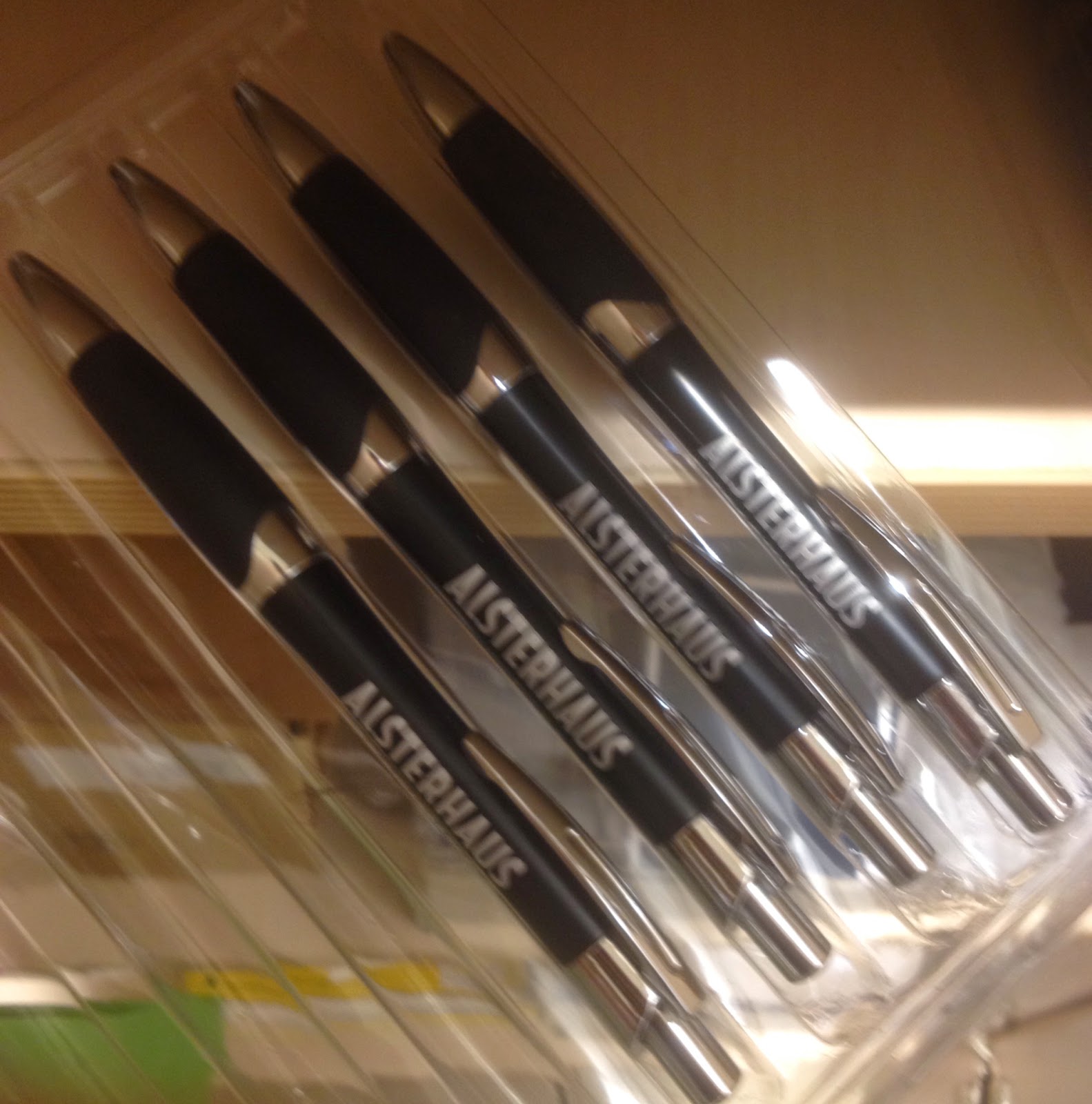
Bingo! Thank you, Herr Neumann. You are warmly invited to collect your congratulatory luxury food hamper from the Alsterhaus Feinschmeckender Boulevard! Actually, you’re not. We don’t sell food hampers, and if we did, I wouldn’t have the authority to offer you one. But here’s a pen with “Alsterhaus” written on it! Thanks again.

Yours sincerely,

Walter Myer
Junior Customer Services Assistant

No one will notice if one goes missing...

This is the letter (and some of the pens) I considered posting today, after an eventual, glorious triumph in my personal game of bingo. Here’s how the game works: every day, I enter the contents of about a hundred handwritten applications for Alsterhaus loyalty cards into the store’s electronic database. One of the fields I am required to enter is the customer’s date of birth, and as I do this, the history of previously entered birthdates with matching digits appears in a pre-emptive pop-up box beneath the field. So having typed “05”, the box might suggest “05.09.1973” and “05.05.1956”, if those dates have already appeared in previous forms. The aim of my game is to use this pop-up to determine whether a certain day (eg. the 5th, the 12th, etc) has appeared in combination with every month of the year. When I find a day that has, I have reached bingo.

I always knew it was a bit weird, but written down it looks pathological. Which makes me think, if it’s hard to explain here, how on earth will I fare in German when Herr Neumann comes to pick up his Alsterhaus branded notepad?

Well, I suspect I’ll have a shot, because the Germans seem to like their numbers. This I’ve learnt recently, with the story of five lottery balls selected in sequential order hitting national headlines. The statistical anomaly was then discussed avidly around the water cooler at work the next day*. Finally, like-minded people! Is what I would've cried if I didn’t find it all a bit boring. So I apply double standards in my passion for different statistical events, shoot me.

That's not Numberwang.
In any case, Herr Neumann may never understand exactly why he made my day. But it’s thanks to his inspired combination of being born on the 20th March and wanting a loyalty card that my game has finally come to an end.

Only, it hasn’t. In bingo, the game ends when someone wins. The participants jealously applaud, the toupéed presenter packs up his equipment and half-baked rhymes, and everyone takes the bus home. Not so in the world of forms. Here, the game runs on long after the initial suspense has been punctured, pressing daftly into the eternal. Or more likely, until the installation of a direct customer interface registry system.

Which is kind of an important point. As much fun as I’ve been able to generate from converting handwriting to Helvetica, I have performed the role of the quintessential superfluous middleman, and even I know that I need to be cut out. It is senseless for customers to provide their details in writing, sitting three feet away from the computer at which an employee will process the information after two weeks of backlog. Give the customer the computer! Help them with it if they’re unfamiliar with the technology, and the paper forms can always be kept as a last resort. But otherwise, it’d be foolish to pass up an option which saves customer time, employee time, and paper. Heed my call, Alsterhaus, and protect the forests. I will now translate this into German and nail it to the entrance of the local church.

*Sadly, this is a proverbial water cooler – customer service annoyingly doesn’t have one. I fill my water bottle from the taps in the toilets.

Monday, August 4, 2014

28/07/2014

Here’s a test. What does the following word say?


It’s not a dash. I know what you’re thinking, and the fourth character is not a dash. It’s a legit letter. Can you figure out which one?

Of course you can’t, it’s a horizontal bloody line. There’s nothing in the Roman alphabet shaped anything like this – and let’s not forget the fact that it’s about triple the width of every other character. If this image were used as a CAPTCHA, anyone in their right mind would fail.

So think of my last two weeks as an extended, advanced-level CAPTCHA examination. As mentioned in the previous article, I have spent large tracts of my time in Customer Service collecting personal information from loyalty card applications and entering it into the store’s database. Poor handwriting has helped punctuate the monotony of the task, but sometimes only by virtue of providing a new, more infuriating exercise, and to this extent it is both a blessing and a curse.

In reading through piles of filled out forms, I am occasionally led to think of the German word for bad handwriting, which is Klaue. This is a good example of the evocative metaphors and language-internal borrowings so common to German* – in its literal sense, Klaue means “claw”. For me, it conjures up the image of a figure hunched over a desk, clumsily clutching a writing instrument between overgrown fingernails and using it to produce a jagged, unintelligible scrawl.

I have seen much of the German Klaue in the past days. When exposed to poor handwriting in large quantities, you begin to learn that the expression of “deciphering”** it is more than just a throwaway dramatisation. With email and postal addresses at stake, and the misinterpretation of a single character risking invalidating hard-won customer information, I’ve needed to develop procedures and techniques to make sense of the senseless. These have included grouping sections of wild pen strokes and mapping them to commonly occurring letter clusters, or trying to correlate the more legible letters in the script with the scratchier parts. When you eventually solve the puzzle, it’s the feeling of recovering a corrupted file, and there is an appreciable sense of satisfaction to it.

There is frustration too. Frustration that some people can’t write their own names and addresses clearly (combined with my suspicion that these same people take some perverse pride in the idiosyncrasy of their incomprehensible style). To some extent, poor handwriting can perhaps be forgiven when the content of the message is interesting, urgent or profound. But it’s a complacent individual who thinks that their home address and phone number fall into one of those categories.

I have enjoyed it, though. Thanks to the highly international Alsterhaus clientele, I now possess gratifyingly inconsequential skills in the identification of nationality through handwriting, whether it be the block-like Chinese rendition of the Roman alphabet, or the neat, tightly italicised cursive of a female Muscovian hand. Only trends, to be sure, and there are no perfectly consistent patterns, but then consistency would spoil the fun. And all the while, plenty of Klaue to keep things vexatious.

It was an ‘m’, by the way – the word spelled ‘Marmstorfer’. I mean, it didn’t, but you know. Customer’s always right. I leave you now with the unhinged handwriting of a man called Ulrich – this is his take on the number ‘15’.


*Though it’s a rubbish example of the better-known German practice of word compounding. For this, note Sauklaue, which adds the word Sau (“sow, pig”) to the original Klaue to produce roughly the same meaning, but with that swine-obsessed Germanic edge.


**The Germans use a similar word for “deciphering handwriting”, namely enträtseln. It literally means “to un-puzzle”. Or, I guess, "to de-cipher". Insightful, Walter.

Wednesday, July 30, 2014

24/07/2014

“You have to type ‘Straße” instead of ‘Str.’.”
“Ok.”
“And if they don’t give their birth date, you just type in 01/01/1900.”
“Got it.”
“Christ, there are so many little details to bear in mind, aren’t there?”
“Yes, so many – how will he ever get the hang of it?”

There were no further little details. And I put it down to my widely celebrated talent for online form completion that getting the hang of it lasted all of about five minutes.

This week, I have entered the world of forms. That is, an intensely bureaucratic, non-platonic world of forms. There are so many forms. There are forms as far as the eye can see. Almost everything you can see is a form, and some of the things you can’t see are also forms. The unseen forms are usually only out of sight because they’re behind other forms.

There are forms for booking train tickets, forms for acquiring cheaper lunch in the canteen, forms for declaring cash levels in the store’s counters, and many, many more. For a diehard bureaucrat, I imagine there’d be nothing like a day of work behind the Customer Service desk to get the blood pumping. But it’s not all forms. Often the forms are contained within folders. In fact, it’s work environments like this which have given rise to the popular German phrase: “Where there are forms, there are also folders*.”

The form I’ve come to specialise in is a very particular and exotic form, used to gather details of applications for Alsterhaus loyalty cards. Learning to enter the contents of these forms onto the Alsterhaus’ online system gave rise to the conversation related above, and it is now my most useful skill, as I spend about three or four hours per day in the pursuit.

The form in question has slowly become the object of my admiration. It is beautifully crafted, quietly serving its purpose without trying to be anything more than it needs to be. It is sly, even cheeky at times, with the section titled “opt in to promotional material” featuring a box which must be ticked to opt out. The form punishes the hasty while rewarding the meticulous, and I like that about it. It’s also in a blue colour scheme, which is always a plus.

This one is pretty close to being platonic.
There are two facets of form processing which have managed to keep my mind distracted from the monotony of the task (I do not fall into the afore mentioned diehard bureaucrat category). One is my development of a rather brilliant game. The other is poor handwriting. Prepare yourself for rollercoaster articles on each when I find the time to write them.


*This phrase is a little like the English “where there’s smoke there’s fire”, with the main difference being that it doesn’t actually exist and I made it up.

Sunday, July 20, 2014

18/07/2014

There have been some very different flavours to my week in Warenannahme, the delivery warehouse. Below I attempt to elaborate on three of my most salient impressions.

--------------------------

If at some point in my life, following a profound turn for the worse in my personal fortunes I resolve to become a highwayman, I know where I’ll set up shop. Namely, on a short stretch of the B4 between Hammerbrook and the old fish market. There, at a little before 6am on weekdays, two trucks drive westwards from Pinkertweg in the North Elbe marshes to the Alsterhaus on the Binnernalster. The wares they carry are diverse, and vary from day to day, with expense and luxury their only shared characteristics.

In the last week, I have seen ranks of Hugo Boss suits, stacks of La Prairie skin cream and crates of Veuve Clicquot champagne pass into the department store stockrooms. It was a little overwhelming initially – but you get accustomed surprisingly quickly to transporting cartons worth a solid chunk of the average German’s yearly salary.

I think that’s partly because some things lose their essential characteristics when taken outside their context. In a store, you are inclined to view every item with a critical eye in judging whether it corresponds with your taste, your lifestyle, your image of yourself. Working with the same items in a warehouse requires the opposite response – unthinking, uncritical dispassion. As my co-workers kept reinforcing, it’s better not to ask too many questions.

This philosophy kind of dissolves the prestige of the objects we deal with – they’re not objects of desire, as they are when placed in a shop window, but rather they become synonymous with a set of tasks to be undertaken and completed. If anyone needs weaning off the excessive fetishisation of goods in our consumerist society, send them to work in a luxury store warehouse. It’ll do them the power of good.

To return to my initial comment, I think that if I had to become a criminal, highway robbery is one of the cleverer picks. Not because it’s any less reprehensible than the others, but rather because it’s so strikingly anachronistic. In the same way we can’t think of pirates today without initially picturing a wooden leg and a parrot on the shoulder, “highwayman” conjures images of daring and bravado. And like pirates, our perception of them isn’t an unambiguously negative one; figures like Robin Hood and Ned Kelly for instance are at worst morally complex, and at best national heroes! When you add to this the expression “highway robbery”, used in contemporary language to refer to normal purchases made at an unfairly high price, it seems that everything today is conspiring to trivialise and romanticise what is basically a worse form of mugging.


I'm sold.
So if job-hunting after university turns sour, look out for me in the streets of downtown Hamburg – homeless, but clad in a Belstaff leather jacket and eating a tin of Beluga caviar.

---

The goods aren’t brought in by barges through the canals, as they once were. And the early morning arguments over misplaced goods are in Turkish and Ibo, rather than Gutnish and Frisian. The hours are shorter, the warehouse lighting more incandescent, and the rat I watched scamper between the crates on Thursday morning, I hope, less plague-ridden.

But there is still something fundamentally Hanseatic about working at 6am in a Hamburg warehouse, with the soft light of the Baltic summer dawn flowing into the dusty loading bay. I know it’s a little fanciful, maybe even contrived, but it’s an aspect of the experience I could rarely keep from my mind for long.

The Bleichenfleet canal leads almost directly to the Alsterhaus back entrance
I should explain that the Hanseatic League and its influence on modern Germany is the object of my academic study for this year, in the form of my 8,000 word Year Abroad Project. If I ever get around to starting work on the reading list’s 88 titles (thanks again Dr Kant!), some more writing on it can be expected here.

You may never have heard of the Hanseatic League. There’s no shame in that – I’d never heard about it either, right up until the first time I did. When I came to learn a little more, I was struck by the significance of the league’s achievements, and was surprised it wasn’t better known.

The League was composed of a number of medieval trading posts, mostly lining or near to the Baltic Sea, and was the most powerful economic confederation of the Middle Ages. It formed what was, in the eyes of some, the first large common market, stretching from western Russia to the Netherlands and the British Isles, but with its core in the German cities of Lübeck, Bremen and Hamburg. The common pursuit of mercantile interests brought about a stable and relatively peaceful cooperative, which in many ways anticipated the structures and stated goals of the modern European Union (just as it prefigured many of the EU’s failures). For me, it is the relative political autonomy and primitive democratic institutions which are of the greatest interest, and I plan on researching how those traditions continue to influence Hamburg today, still officially styled as a “free and Hanseatic city”.

It doesn't take a degree in languages to translate the top line.
As suggested, I’m yet to start that research. Perhaps that’s what allowed my groundless, uninformed perception of a “Hanseatic” image or feel to take root in the last week of work. If so, then I’m glad for my relative ignorance on the subject just for the moment – it has given rise to that fantastical, idealistic and deeply personal conception of the past which is at once both stupid and sacred. That will be the sacrifice as I begin work on the project this year – I can only hope the fascinating reality of the Hanse’s long history will provide an equally compelling recompense.

---

It’s very nice to talk about the pretty morning light on the warehouse floor. But those transporting moments were few in a week which for me felt overwhelmingly real. It was the first time I’d properly worked in manual labour, and I had expected it to be physically tough. In fact, it wasn’t really. Of course there was the odd strain heaving heavy boxes onto palettes or rollers, and the aromas of the on-site garbage compressor weren’t particularly pleasant, but it was all pretty bearable.

What was tough was the mental side. Not because it was intellectually challenging, but rather the opposite – it presented something of an intellectual vacuum. Procedure and orders dominated, meaning that there was rarely any stimulus for independent thought or problem-solving. This frustrated me, because I’m used to exercising my mind regularly, if only by virtue of being within some schooling context or other for the last fifteen years.

But it wasn’t just me it frustrated. I spent a lot of the time talking with a man who came originally from Nigeria (and hence spoke perfect English, along with Ibo and second-language German). While thankful for the opportunity to work, earning money for his family back home, he was just as conscious of the job’s mental void as I was. He told me about the ways he tried to deal with it, by joking with his co-workers, laughing more. That helped a little, but only as long as there was work to be done. In the warehouse, often that isn’t the case – the vapid pushing about of cartons is poorly complemented by the idle hours of waiting between the departure of the loading trucks and the arrival of the post, or after the post is gone and the palettes have been stacked.

Not much going on here.
It can’t feel very inspiring working in an environment like that, and I wouldn’t wish that mental stultification on anyone, least of all a hard-working, ambitious, trilingual immigrant. It’s essential work which people need to do – and of course, it requires a certain amount of skill and experience to do well, both of which I lacked. But I think being placed in the shoes of a warehouse worker for a week (literally, actually) has helped me begin to appreciate what is hardest about this line of work, and it’s not what I’d expected. People want to use their minds when at work, and that can be just as true for warehouse hands as it is for management consultants. I think that has been the lesson of the week, and it’s a thought I intend to hold onto.

--------------------------


Now, with my week in the warehouse over, I’m moving into the relatively cushy department of customer service for the next three. Not sure exactly what it will entail, but I’ll no doubt find out soon. Wish me luck!